
Industrial AI: Without Reliable Data, Artificial Intelligence Is Useless
Artificial intelligence is now established as a strategic lever in industry. Predictive maintenance, process optimization, advanced supervision, and decision support are among the most common promises. Yet on the shop floor, a simple reality quickly emerges: industrial AI only creates value if the data it relies on is reliable, continuous, and properly contextualized. This perspective has been widely echoed in several industry publications, including an article published by ia-news.A Heterogeneous Industrial Environment, Far from “Ideal” Data
Unlike consumer AI, which is often fed by massive volumes of relatively homogeneous data, industrial AI must operate in complex, multi-equipment, and often constrained environments. Legacy PLCs, sensors from different generations, multiple communication protocols, noisy or incomplete data: the industrial landscape is anything but standardized. As a result, without a dedicated data foundation, information is frequently fragmented, inconsistent, and difficult to scale across sites or systems.The First Challenge: Data, Not the Algorithm
In many projects, AI is still approached primarily through the lens of models and algorithms. In industrial contexts, however, the real challenge lies upstream: data collection, structuring, and governance. It is essential to be able to:- Communicate with a wide variety of equipment
- Decode and normalize heterogeneous data streams
- Guarantee data continuity (no “gaps”)
- Contextualize each data point (machine, batch, setpoint, event, operating conditions)
Quality and Context: The Condition for AI Performance
Industry does not lack data: it generates it continuously. But volume alone is not enough. Value lies in quality, consistency, and above all in the ability to link each data point to its operational context: asset, setpoint, production rate, environment, maintenance activity, or changeover. Without this context, AI models may detect correlations, but struggle to deliver robust, explainable, and actionable results on the shop floor.Interoperability and Sustainability: Avoiding the Trap of Closed Architectures
Another common pitfall is technological dependency. Too many projects rely on closed architectures that work for a proof of concept, but fail to scale or evolve over time. In industry:- equipment can remain in operation for decades
- protocols and use cases evolve
- compliance and cybersecurity requirements increase
Security and Trust: A Non-Negotiable Foundation
As AI initiatives connect to enterprise systems (ERP, MES, SCADA, BI, cloud platforms), cybersecurity and data integrity become critical. Compromised, altered, or incomplete data can lead to flawed decisions, directly impacting quality, compliance, and operational continuity. Securing data flows and ensuring traceability are therefore essential to build trust in AI-driven outcomes.A Pragmatic, Field-Oriented Approach to Industrial AI
High-performing industrial AI relies on a foundation that is often invisible, yet fundamental: mastery of the field. Collect better, understand better, structure better, before attempting to predict or automate. In this context, artificial intelligence is not an end in itself, but a tool serving reliability, industrial performance, and decision-making quality. One principle remains constant: without high-quality data, there is no real intelligence.DevI/O: Structuring Industrial Data to Make AI Operational
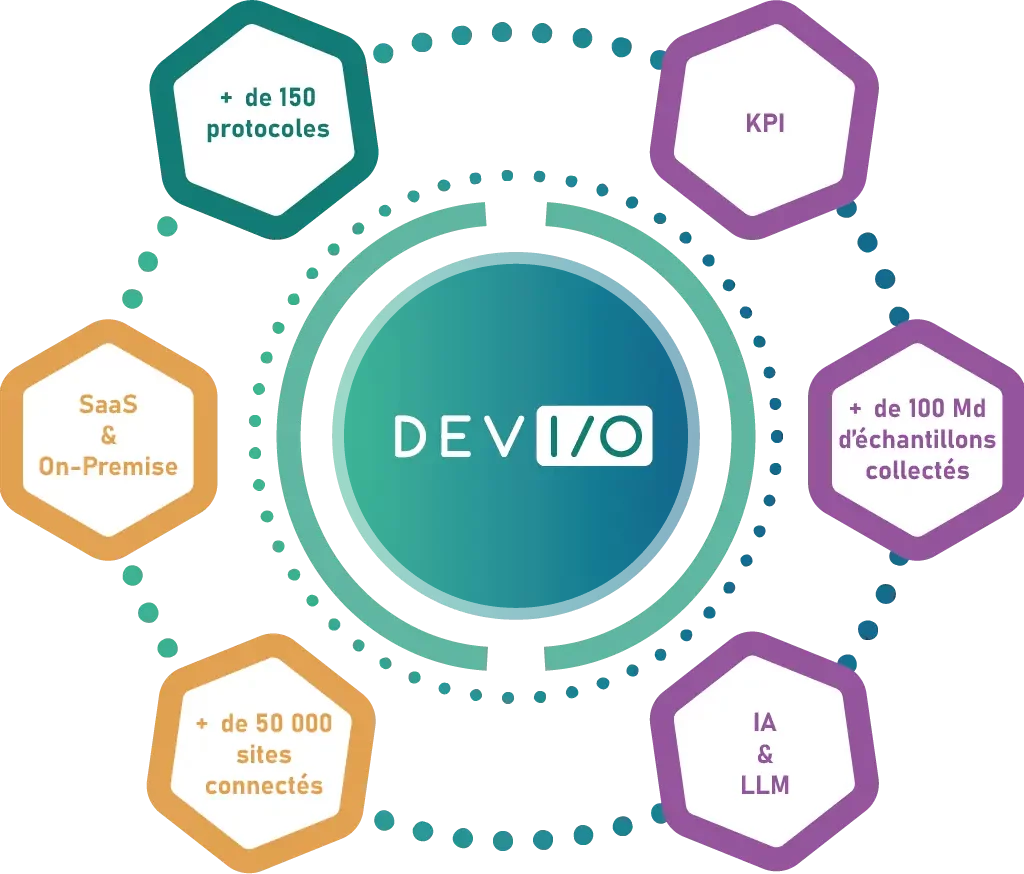
This is where dedicated software layers for data collection and orchestration become essential. With DevI/O, TECHNILOG provides a platform designed to address real-world industrial constraints: equipment diversity, multiple communication protocols, security requirements, and data continuity. DevI/O enables you to:- Collect field data from heterogeneous environments (PLCs, sensors, BMS/BAS, IoT)
- Normalize and structure multi-protocol data streams for operational use
- Contextualize data (timestamping, consistency, continuity) before AI exploitation
- Secure communications and ensure end-to-end data integrity
- Distribute data to enterprise and analytical systems: ERP, MES, SCADA, supervision, cloud, and AI platforms
By Benoit VALLET, AI Engineer at TECHNILOG
The DevI/O Communication Gateway
The DevI/O communication gateway connects, unifies, and secures data exchanges between equipment and applications, ensuring seamless, reliable, and high-performance integration within industrial systems.