
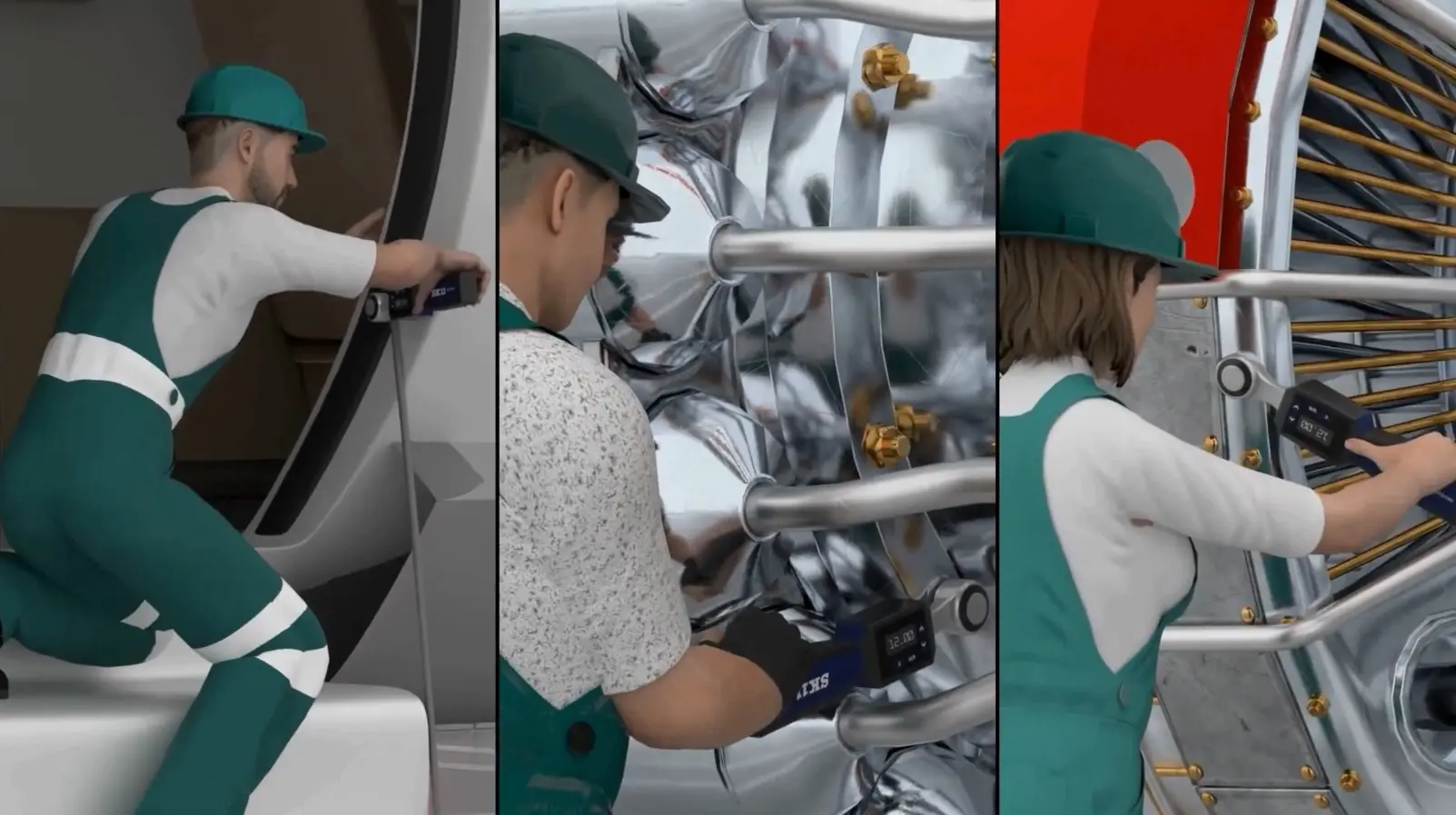
In industry, tightening operation traceability can no longer be limited to a partial data feedback loop. Connected tools now generate high-value data that supports quality, compliance and continuous improvement. The challenge is to collect, secure and integrate that data efficiently into industrial systems. With Qualitrack, Technilog provides an open and structured approach to connected tightening tool traceability.
Key takeaways
- Connected tightening tools generate data with strong industrial value.
- The core challenge is no longer limited to a final result being reported, but to the reliable and complete use of operational data.
- Multi-brand and multi-system environments require an open and interoperable approach.
- Qualitrack enables manufacturers to capture, structure and leverage tightening data within their existing industrial ecosystem.
When tightening data becomes a true industrial asset
In many production environments, tightening operations are part of critical assembly steps. They directly impact final product quality, process compliance and, in some industries, the ability to demonstrate that an operation was performed under the expected conditions.
For a long time, tightening traceability was handled only partially. Some data was collected, while other information remained locked inside the tools, proprietary software, or environments that were difficult to interface with the wider industrial information system.
Connected tightening tools have significantly changed this landscape. Intelligent torque wrenches, connected nutrunners and instrumented drilling tools now generate valuable data such as applied torque, operation status, operator ID, timestamp, selected program, alerts and critical events.
The limitation of closed environments
In real industrial settings, production sites rarely operate with a single manufacturer, a single protocol or a single business system. Workshops often combine heterogeneous equipment, multiple generations of tools and various integration constraints.
In that context, a closed approach quickly reaches its limits. When a tool only exposes part of its data, or can only communicate within a restricted framework, manufacturers lose a significant share of the value produced on the shop floor.
Direct consequence: traceability becomes less complete, exchanges with existing systems become more complex, and cross-functional use of industrial data is reduced.
Qualitrack: enabling tightening data to flow without losing value
With Qualitrack, Technilog delivers a concrete response to this challenge. The solution allows connected tightening tools to transmit the full scope of the data they generate, without locking it into a proprietary logic or a partial usage model.
The objective is clear: capture the richness of the information available at tool level, secure it, and make it usable within the customer’s industrial environment.
Capture
Collect relevant information directly from connected tools and tightening operations.
Structure
Turn scattered technical data into coherent, readable and usable industrial data flows.
Secure
Preserve data integrity and maintain traceability continuity over time.
Leverage
Feed industrial and business systems with data that supports quality, analysis and operational control.
Traceability designed for multi-brand environments
One of the main challenges in tightening traceability lies in the diversity of installed tool fleets. Many industrial sites use multiple tool references, often coming from different manufacturers.
This heterogeneity is not an exception. It is a common reality that requires solutions capable of interacting with a wide range of environments, without forcing a full redesign of existing systems.
Qualitrack is built around this open approach. The solution connects intelligent tightening tools within a consistent architecture in order to collect and structure the generated data, then redistribute it to the appropriate industrial systems.
Why this approach makes a real difference
- It avoids the multiplication of technical silos.
- It restores visibility across production data flows.
- It enables the native capabilities of connected tools to be used beyond the final tightening result alone.
- It positions tightening data within a broader industrial performance strategy.
From connected tools to industrial systems
The value of a data point depends not only on its quality, but also on its ability to reach the right destination. In an industrial context, data generated by a tightening tool must not remain isolated.
It must be able to feed the systems that rely on it, including:
- ERP
- MES
- SCADA
- CMMS
- BI
- quality, supervision and analytics platforms
This is where a communication front-end dedicated to traceability becomes essential. Qualitrack ensures continuity between the shop floor and industrial applications, so that data produced by tools does not remain trapped at the edge of the information system.
Useful data is continuous, reliable and actionable
In a workshop, traceability cannot be reduced to the occasional existence of a data point. To be truly useful, data must be preserved, secured, historized and reusable.
Missing, fragmented or difficult-to-interpret data loses a large part of its value. By contrast, properly collected and structured data can strengthen quality processes, support post-operation analysis and improve production monitoring tools.
Beyond compliance: making better use of native tool capabilities
Connected tools do not generate final results only. They often provide capabilities that go far beyond what organizations actually exploit.
Program information, operating states, alerts, events, cycle data, history and maintenance indicators can all provide tangible value when captured, structured and integrated correctly.
The challenge is not only documentary. It is operational as well. By making better use of data generated close to the process, manufacturers gain visibility, responsiveness and analytical capability.
A practical demonstration at Global Industrie Paris 2026
Technilog’s presence at Global Industrie Paris 2026 reflects the intention to demonstrate, in concrete terms, how tightening tool traceability can evolve.
Through Qualitrack, the goal is to highlight a reality that is still often underestimated: the richness of the data generated by connected tools, and the need to use that data within an open, interoperable framework that is directly useful to industrial environments.
FAQ about connected tightening tool traceability
What is connected tightening tool traceability?
Connected tightening tool traceability consists in collecting, securing, historizing and using the data generated by torque wrenches, intelligent nutrunners and other assembly tools in order to ensure reliable monitoring of industrial operations.
Why is tightening traceability important in industry?
It strengthens quality, compliance, operational continuity and production data usage. It also helps integrate shop-floor information into industrial systems such as ERP, MES and SCADA.
What is the benefit of a multi-brand approach for connected tightening tools?
A multi-brand approach makes it possible to integrate heterogeneous tool fleets without creating additional technical silos. It simplifies the collection and structuring of tightening data in complex industrial environments.
What is Qualitrack used for in an industrial architecture?
Qualitrack acts as a link between connected tightening tools and industrial systems in order to collect, secure and leverage tightening data within a traceability, quality and operational data usage framework.
Conclusion
As workshops become more connected and quality requirements continue to increase, tightening data is becoming increasingly strategic.
Too often, this data is still only partially used, locked into limited technical frameworks or insufficiently integrated into the company’s industrial systems. The challenge is no longer simply to retrieve information, but to preserve its full value.
This is exactly where Qualitrack fits in: an industrial traceability approach designed to capture, structure, secure and leverage data generated by connected tightening tools, so that shop-floor data can serve real business and operational needs.